
Help I’m a new(ish) subject lead
3 November 2026

Step 1 – don’t panic

As the SIP left, it would have been easy to panic. Throw everything out, burn the lot, it’s all wrong. We should just start again with something completely new. But the children will always need teaching in the morning, so that’s perhaps not the best option.
Instead, take a moment. Probably more than one moment in fact. You don’t need to have all the solutions by the time your SIP has left the car park. Really, that is what this whole blog is about. It is better to construct a long term plan based on good evidence and divided into manageable steps that your colleagues can really get on board with. So, how did I go about doing that?
Step 2 – look at your data

For us, I looked at the data for every year group, autumn and summer for the previous year. I was asking myself: which year groups were performing well or not so well? Why? What were the differences? Which team members might need more support? Could I spot common strengths and weaknesses amongst our student mathematicians?
At my school, all of our data is stored centrally so anyone can access it at any point, which is really helpful for this stage of school improvement. For me, a person who is quite happy to be surrounded by numbers, compiling spreadsheets and looking for patterns and averages, this is my happy place. If you aren’t quite so comfortable with data, there will be someone in your school hiding a deep-rooted passion for it. Hunt them out, ask them for a favour – they will thank you for it. In our data, I learned two things. 1. We had very skilled mathematicians: many of them could crunch numbers as well as Excel. 2. For some reason, as a whole school, our children were struggling to access reasoning questions. My mission was to find out why.
Step 3 – watch, listen and surround yourself with the right people
Once the data has given you some leads, it is crucial to go and test your hypothesis by talking to everyone and anyone who will listen to you bang on about your subject for 30 seconds. Take this opportunity to have conversations with staff. Be open with them, ask them what is working for them, what do they see as needing to change, why? Make sure you also speak to the children. For me, I spoke to a whole range of children, including sending out a questionnaire to upper Key Stage 2. (You guessed it – more data!).
Look for wisdom outside your school as well. We spoke to schools who had already started to change their approach to Maths. The local Maths Hub, Maths leads in other schools, members of staff who had an interest in Maths and other members of SLT all helped formulate our plan. Make sure that you work with people and organisations that have similar ways of working and educational philosophies – you don’t want to end up uprooting your entire school’s vision and values in the name of Maths improvement!
Step 4 – Create a sustainable long-term plan
Change takes time. Schools often have multiple priorities. Make sure you are committing to a plan you are confident will work – staff won’t thank you for doing a 180 after 18 months of a new approach. Then, when creating your plan for your subject, break it into bite-sized chunks. Staff have limited capacity to engage with a change in approach and your priority might not be their priority.
Don’t over-commit what you are going to implement in a particular timeframe and definitely don’t move on until the whole school is ready.

Our plan over the last three years for Maths went something like this:
- Map out some long term planning for each year group
- Achieve consistency across every class in terms of teaching approach
- Practice, practice, practice
- Focus on factual fluency and times tables
- Tackle reasoning
- Turn Year 6 into a competitive sport (hear me out before you make a judgement…)
- Embed Mathematical vocabulary
NB: I’ll be writing a post about each of these as soon as possible!
Some of these steps were one staff meeting, share the resources, a week to implement across the year groups and they were done. Others we have been working on for three years, held staff meetings, coached staff, carried out peer observations, held more staff meetings and we are still working on them.
Step 5 – Implement
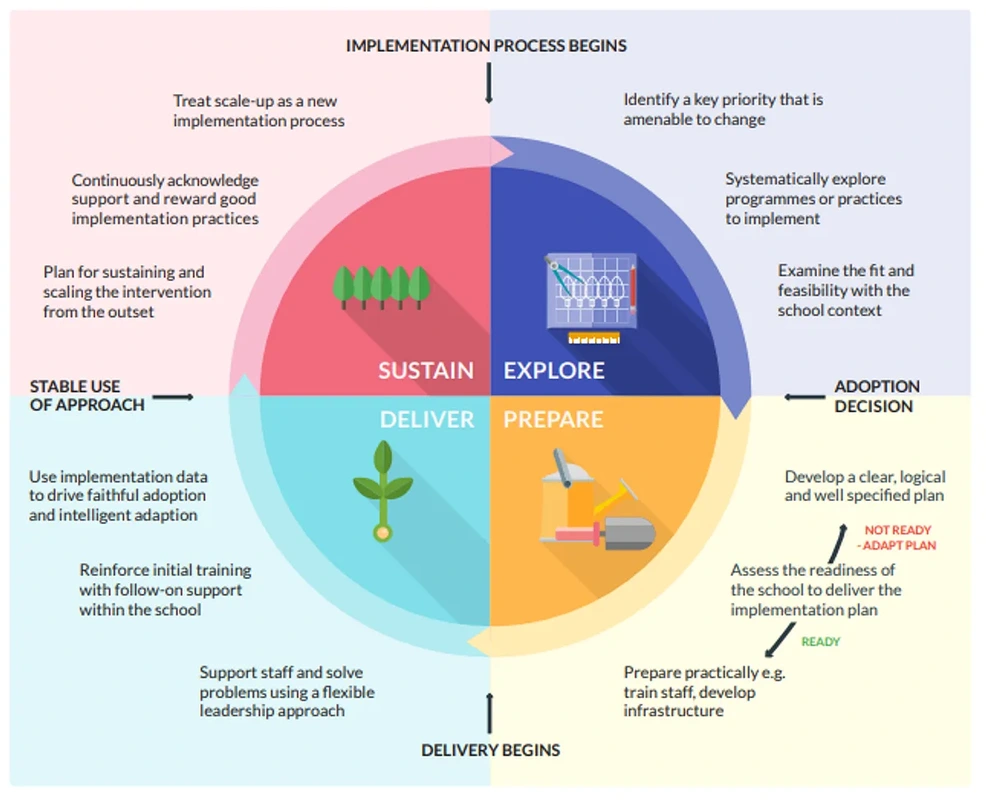
So what did our SIP think?

However, as much as I enjoy randomly bursting into song about the house and in the classroom, my life isn’t a Disney film. We didn’t need a revisit this time to reflect on the success of our new approach. We are grateful that our SIP came in and really made us think carefully about what we are doing but it ultimately doesn’t matter what one person thinks of our teaching. Instead, you can come into school any day at about 9am or talk to the children about Mathematical concepts or look at our data (mmmm more data) and the upwards trajectory is there.
Across a series of blogs, I am going to try and describe the journey we have been on in more detail. So far, it has taken us over three academic years. We haven’t done everything perfectly and the journey isn’t over yet, but I’m incredibly proud of
everything the staff and children have achieved over the past three years.
Rule 4 – Turn it into a team game with the children

There are two key words in Rule 4: team and game. Almost all children love games and those that love games, love to win at games even more. Therefore, we try to turn a lots of practice into games and there is always a prize to be won – 5 minutes extra play, a sticker, biscuits, dances – nothing major.
We run practice papers 4 times a year, which I know will make some uneasy. However, by the time mid-year rolls around, the vast majority of children are simply focused on beating their last score or getting 100%. They just see it as a game, something to win and be successful in. Furthermore, by the time May comes around, they are so use to them, it’s just another paper and they know they are successful at them.
We know that the class class achieves more if everyone is working together. For this reason, a lot of the games and challenges are completed as a whole class or in pairs. I have some examples of games we play below to try and help illustrate this point.
- We play Maths Bot a lot (it often becomes a little bit of an obsession). However, its always a game. How many correct answers can we get as a class in 15 minutes (answer normally over 500). Which pair can score 40/40 first (I’ll choose who in the pair can hold the pencil so one person dosn’t become redundant whilst the other flies through the Q’s). How many 40/40’s can we get as a class first time of asking (somewhere near 20/30). All of these records are written up on the board at the front of the classroom.
- Each morning starts with 5 maths questions on the board based on what the children need to work on. The record for number of children getting each question correct questions is written on the board. If we beat the record, we ring the winner’s bell – loudly, just to annoy the neighbours. If we get 30/30 on any question we get some extra play. But it must be 30 – no excuses.
- We hold several pub quizzes later in the year focusing all around the curriculum.
Rule 5 – run extra groups and run them early
Extra groups are controversial, I know. The extra pressure on both children and teachers. However, the growth and progress we see in these groups every single year makes it some of the most worth-while teaching we do. Also, the children do love it (and the occasional early morning biscuit) because they want to be the best they can be. We have spent years telling them if they practice anything they will achieve. Last year, I made the last week of term optional. I still had a group of 21 rock up Monday morning.
If you are going to do them, they must be frequent, start early in the year and, preferably, early in the day. Where I currently teach, we run our maths groups from October half-term, 8:00-8:45 Monday – Wednesday, with the same children attending all three. SPAG starts after Christmas. Every year I meet teachers who are starting the groups once a week after February half-term. This year that would be 8-9 hours of practice. Meanwhile children at my school we will be offered 49.5 extra hours for Maths and 18 for SPAG this year.
Everyone has been there, trying to force some Roman aqueduct knowledge down the children’s throats at 14:45 on a Wednesday afternoon – not exactly a highlight of my week. So why would fraction practice and hour later be any different? Get them in early, whilst their wide awake and eager – just grab an extra coffee on your way past the staff room. Going back to my previous point about getting everyone onboard, one group is always run by the head of school and deputy, whilst the Year 6 team share the other. No class teacher can (should) run three early morning a week. This is a load which must be shared. If you’re a Year 6 teacher who is worried about trying to get your SLT onboard – show them this blog and tell them to get in touch.
Finally, don’t cancel these groups. I try to never simply cancel the sessions because I can’t make it. At some point last year, the head of KS2 took a couple of sessions or my partner teacher ran some of mine. So many adults stepped up to the plate, it would be tricky to name them all. In my eyes, cancelling them sends the wrong message.
A couple of extra tips for running the groups –
- We offer free breakfast club places for all siblings. Parents love it, siblings get to play with their mates and its a barrier to access which has been broken down at no cost to the school.
- These are small groups, exclusive invite only. we try to keep the numbers below 20 and they are split based on ability. There is very little point having someone, who you want to score 110+, spending their mornings practicing addition with 4 digits.
- We don’t call it Sats boosters. We all know they are, the children all know they are, the parents all know they are. However, by calling it Maths groups and SPAG groups, I think it gives the emphasis that we are trying to build champion mathematicians and writers not someone who can simply pass a test.
- To make the most out of them, have a plan. Go back to the data what do the individuals attending need.
Rule 6 – Be prepared to celebrate the success

The best part of all this is about celebrating the successes and there will be many along the way. Seeing that child’s face when they score 100 scaled for the first time, knowing all their hard work is paying off, watching them dance and high-five their friends, these moments bring out such a special feeling. The children have worked hard for these moments, go over the top, bring the biscuit tin and stickers out, dance with them and enjoy the moment – show them you are proud of them.
We have a 100% club – children who score 100% in any paper. They are often found legging it down the corridor, paper in hand trying desperately to find the head teacher. Year 6 children often start the year thinking it isn’t possible, no way am I joining the 100% club. However, as soon as the first one achieves it, everyone knows its possible and it’s suddenly a goal for a large group of children. In 2023 and 2024, during the final paper, 13 children achieved this in Arithmetic both years, with a further 13 falling 1 mark short each year. Sure the standard is unbelievably high but I’m yet to meet a child who scores 39 or 40 on an arithmetic test and not make the standard over all, although I am sure they are out there. As an aside, I have never correctly predicted the members of this club – there are always 3 or 4 surprises throughout the year.
Rule 7 – Don’t narrow the curriculum
I don’t really have a lot to say about this apart from there are two reasons why we try at all times to provide abroad and balanced curriculum:
1 – narrowed curriculums puts children off. Yes Sats are important but children still deserve all the other learning that makes primary schools wonderful places.
2 – Ofsted want broad and balanced curriculums and that doesn’t stop when they get into year six. It doesn’t matter how good your results are if the children are missing every other subject.
Sure, in the last three weeks (after Easter) we break this slightly. But, until that point, the weekly plan doesn’t change – the children need it all from P.E. to R.E. and its only fair we provide it.
This year
Hopefully, this has provided some insight into how we run things in Year 6. I firmly believe that it is a mixture of all these rules that have made us successful. Because of this, this blog was really difficult to write and order as everything seem so important, it all needed to come first.
Over the coming weeks, my partner teacher and I will write a couple of blogs for each subject in Year 6. However, in the mean time, please ask any specific questions on Social media or in the comments below.

